Tree Health Assessment in McKinney, TX

Expert diagnosis of tree diseases, pest infestations, and structural problems — with clear treatment plans to save your trees.

Tree Health Assessment in McKinney TX Schedule an Assessment

Understand What's Happening With Your Trees

A tree that looks fine from a distance can be silently declining. Fungal infections, boring insects, root rot, nutrient deficiencies, and internal decay often develop for months or years before visible symptoms appear — and by then, treatment options may be limited. NTX Tree Experts provides comprehensive tree health assessments that catch problems early, when intervention is most effective and least expensive. Our evaluations cover everything from canopy condition and bark integrity to root zone health and soil composition.

North Texas trees face a specific set of threats. Oak wilt is an aggressive fungal disease that has killed thousands of red oaks and live oaks across Collin County. Hypoxylon canker attacks stressed post oaks and other hardwoods, especially after drought. Emerald ash borer, while still moving through Texas, poses a growing threat to ash populations. Bacterial leaf scorch, cotton root rot, and various scale and borer infestations are also common in the McKinney area. Our arborists know these local threats inside and out and can identify the telltale signs that general landscapers often miss.

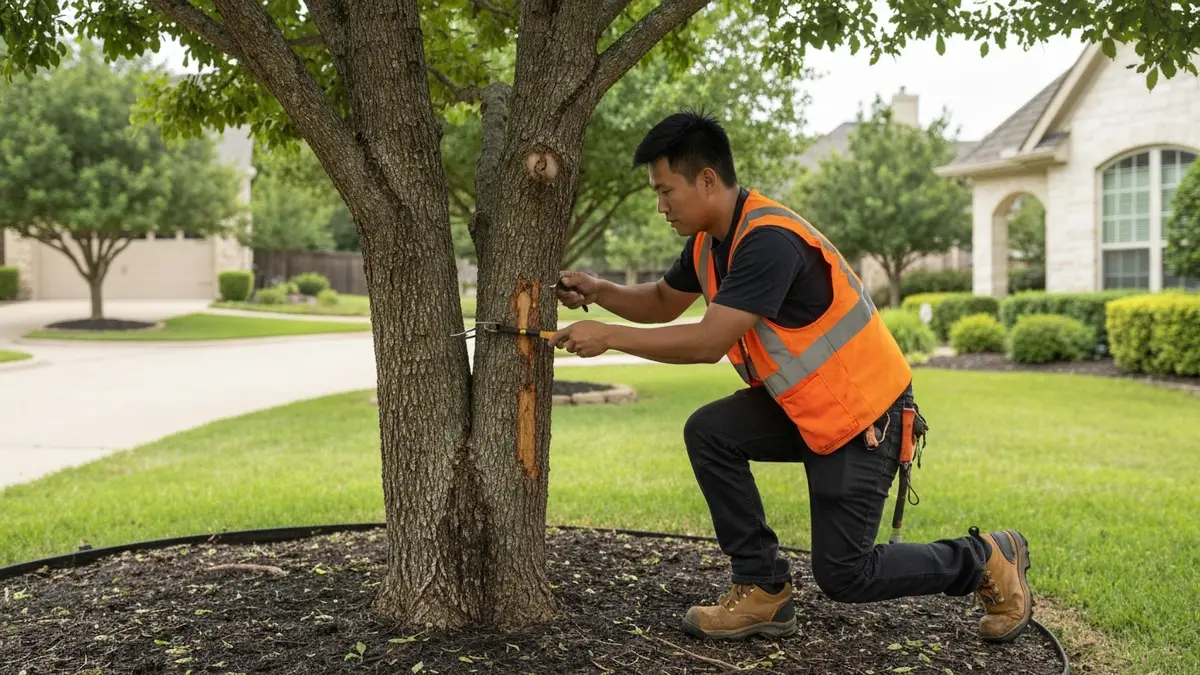
During a health assessment, we examine the entire tree systematically: the crown for dieback, discoloration, and thinning; the trunk for cankers, cracks, fungal fruiting bodies, and boring insect activity; the root flare for girdling roots, soil compaction, and signs of decay; and the surrounding soil for drainage problems and nutrient issues. When deeper investigation is needed, we use tools like resistograph drilling to map internal decay and soil probes to assess root zone conditions.

Every assessment ends with a clear, written report that includes our findings, a risk rating, and a recommended treatment plan. If the tree can be saved, we outline the steps — whether that is targeted pruning, fungicide injection, insecticide treatment, soil amendment, or a combination of approaches. If the tree is beyond recovery or poses an unacceptable safety risk, we will tell you that honestly and help you plan for removal and replacement.

What Our Assessment Covers

  • Canopy evaluation — Crown density, dieback patterns, leaf discoloration, and abnormal growth.
  • Trunk and bark inspection — Cankers, cracks, cavities, fungal conks, and insect boring activity.
  • Root zone analysis — Girdling roots, soil compaction, drainage issues, and root decay indicators.
  • Pest identification — Species-specific diagnosis of insect infestations and boring damage.
  • Disease diagnosis — Identification of oak wilt, hypoxylon canker, bacterial leaf scorch, cotton root rot, and other local diseases.
  • Written report and treatment plan — Clear findings, risk rating, and recommended next steps.

Why Choose NTX Tree Experts for Tree Health?

  • Deep knowledge of North Texas tree diseases and pest pressures
  • Systematic, science-based evaluation process — not guesswork
  • Advanced diagnostic tools including resistograph and soil probes
  • Written reports with photos for your records and insurance
  • Honest recommendations — we will never upsell treatment on a tree that cannot be saved
  • Treatment services available in-house: pruning, injections, soil work, and removal

Service Areas

Worried About a Tree? Get a Professional Assessment.

Early detection saves trees and money. Call today to schedule your on-site evaluation.

(469) 529-6768 Request a Quote Online
Call Now Free Quote

Our tree health assessment services in McKinney, TX give you a clear, expert diagnosis of exactly what's wrong with your trees — and what it will cost to fix it — before you spend a dollar on treatment. NTX Tree Experts sends a certified arborist to evaluate canopy density, bark integrity, root zone condition, and soil health on-site. Most assessments are completed in under 90 minutes, and you receive a written report the same day with a prioritized treatment plan.

What We Diagnose

North Texas trees face a specific and aggressive set of threats. Oak wilt alone has killed more than 1 million trees across Texas and spreads rapidly through root grafts between neighboring red oaks. We also identify hypoxylon canker, cotton root rot, emerald ash borer damage, iron chlorosis (extremely common in McKinney's alkaline clay soils), and structural defects like included bark and co-dominant stems that raise storm failure risk. Early detection reduces treatment cost by 40–60% compared to late-stage intervention.

How the Assessment Works

A certified arborist walks the property, inspects each tree visually and with a mallet tap test for hollow wood, then evaluates the root flare and soil compaction. For suspected internal decay, we use a resistance drill or sounding techniques — no guessing. You get a written findings report, a risk rating per tree, and itemized options ranging from targeted fungicide injection to monitored observation.

Assessment Cost & Scheduling

A standard residential assessment for 1–5 trees runs $150–$300 depending on property size and access. If you proceed with treatment, the assessment fee is credited toward the work. Same-week appointments are typically available across McKinney, Frisco, Allen, and surrounding Collin County communities.

Call (469) 529-6768 or use the form below to book your tree health assessment and get a same-day written report from a certified arborist.

Our tree health assessment and inspection services in McKinney, TX identify diseases, pest infestations, structural defects, and root zone problems before they become removal emergencies. NTX Tree Experts performs a full diagnostic evaluation covering canopy density, bark condition, root flare health, soil compaction, and signs of internal decay — and delivers a written treatment plan the same visit. Most assessments take 30–60 minutes and cost between $75–$150, a fraction of what emergency removal runs after a tree fails.

What We Inspect During a Tree Health Evaluation

Every assessment covers six diagnostic zones: canopy and foliage (color, density, dieback), bark and cambium layer, branch structure and attachment angles, root flare and soil grade, signs of fungal activity or boring insects, and overall lean or load risk. For North Texas trees, we specifically screen for oak wilt — a fungal disease that spreads through root grafts and has killed thousands of red oaks across Collin County — as well as hypoxylon canker, emerald ash borer, and cotton root rot.

When to Schedule a Professional Tree Inspection

McKinney homeowners should book an inspection if they notice crown thinning, early leaf drop, soft or discolored bark, fungal conks at the base, or any lean that wasn't there last season. Trees within 20 feet of a structure warrant annual checkups regardless of visible symptoms — roughly 70% of tree failures in urban settings involve decay that was detectable at least two years before the tree came down.

What Happens After the Assessment

You receive a written findings report with photos, a diagnosis, and a tiered treatment plan — from soil amendments and targeted fungicide applications to cable bracing or, when necessary, a removal recommendation. We don't upsell removal when a tree can be saved; our revenue model is built on long-term tree care, not one-time cuts.

Call (469) 529-6768 or schedule online to book your McKinney tree health inspection — same-week appointments are usually available.